Back
Finding the right demand planning software – Tightly, RELEX and o9
Laura B
Marketing Analyst
The "best" software does not exist in a vacuum.
A platform’s effectiveness is entirely dictated by its alignment with your specific operational DNA—whether you are managing the high-turnover perishability of groceries, the extreme seasonality of luxury apparel, or the massive global interdependencies of industrial manufacturing.
When businesses start looking for ways to predict what their customers will buy, they often search for the best demand planning software on the market. However, comparing these tools is rarely a fair contest. Supply chains are wildly different depending on what you actually sell. In this article, we will look at three top-tier systems—Tightly, RELEX Solutions, and o9 Solutions—and explore how they cater to the market.
→ Industry DNA is the Secret Ingredient
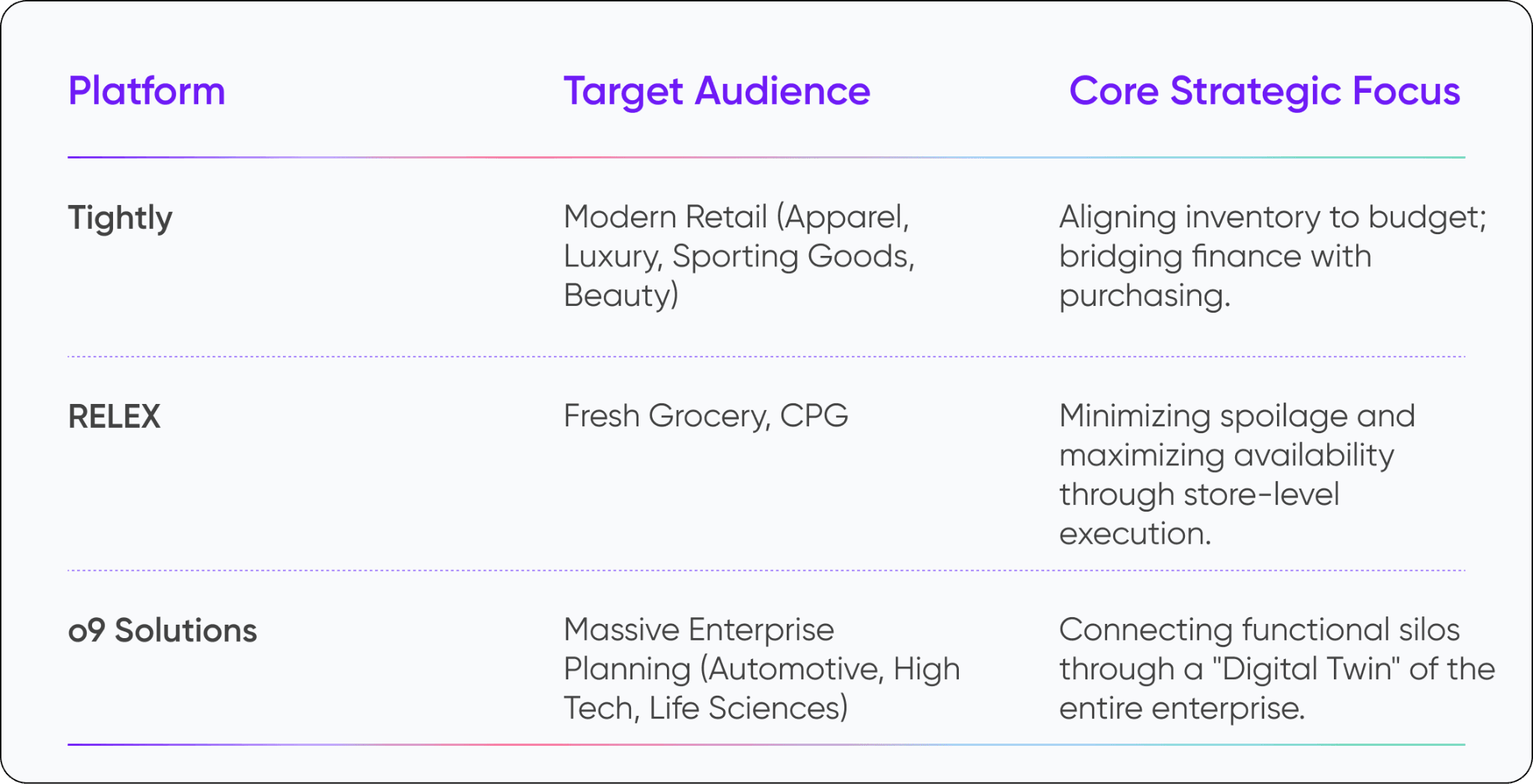
Every enterprise planning platform is architected for a specific "ideal user." This "Industry DNA" dictates the underlying logic of the software. A tool built for groceries must prioritize "spoilage logic" and shelf-life constraints, whereas a tool for luxury apparel must master "size-curve logic" and "initial allocation" for product launches that lack historical sales data.
Industry Fit & Core Focus
→ Tightly: The Growth Engine for Modern Retail and E-commerce
For organizations generating $70M+ in annual revenue, the stakes of inventory management shift from basic tracking to strategic capital orchestration. Tightly is the go-to for high-growth brands that require a tight, real-time link between financial strategy and inventory actions through advanced demand sensing. It's built specifically for scaling e-commerce brands, direct-to-consumer (DTC) businesses, and companies with hybrid models that both buy and manufacture their own goods. If your brand relies on custom assembly, kitting, or in-house manufacturing, standard inventory tools often fall short because they cannot see your production realities.
And nowhere is this gap more dangerous than in the makeup and cosmetics industry.

A look at the minimalist, peptide-powered skincare lineup from Rhode Skin, emphasizing barrier-focused ingredients. (Source: rhodeskin.com)
The beauty industry moves incredibly fast, relies heavily on digital hype, constantly launches new products, and often bundles items together—all of which are exactly what Tightly was built to handle. Key tools and how they help this industry:
In-House Assembly Control: Using a Bill of Materials (BoM) and Manufacturing Orders, Tightly seamlessly manages hybrid models, tracking the raw materials (formulas, bottles, boxes) needed for custom assembly so production never stalls.
Real-Time Trend Tracking: By linking to your live GA4 website traffic, Tightly instantly spots fading viral trends to prevent over-ordering, and highlights highly-viewed but out-of-stock items so you can recover lost "Ghost Revenue".
Data-Driven New Drops: The Initial Allocation tool allows brand-new shades or limited drops to inherit the proven sales history of past successes, giving you an accurate forecast from day one and eliminating the guesswork of new launches.
Smart Replenishment & Execution: Tightly acts as a network-aware execution layer. Instead of simply telling you to "buy more," it evaluates your entire network and automatically routes your restocking needs into Purchase Orders (buying), Transfer Orders (moving existing stock between your warehouses), or Manufacturing Orders (building it yourself).
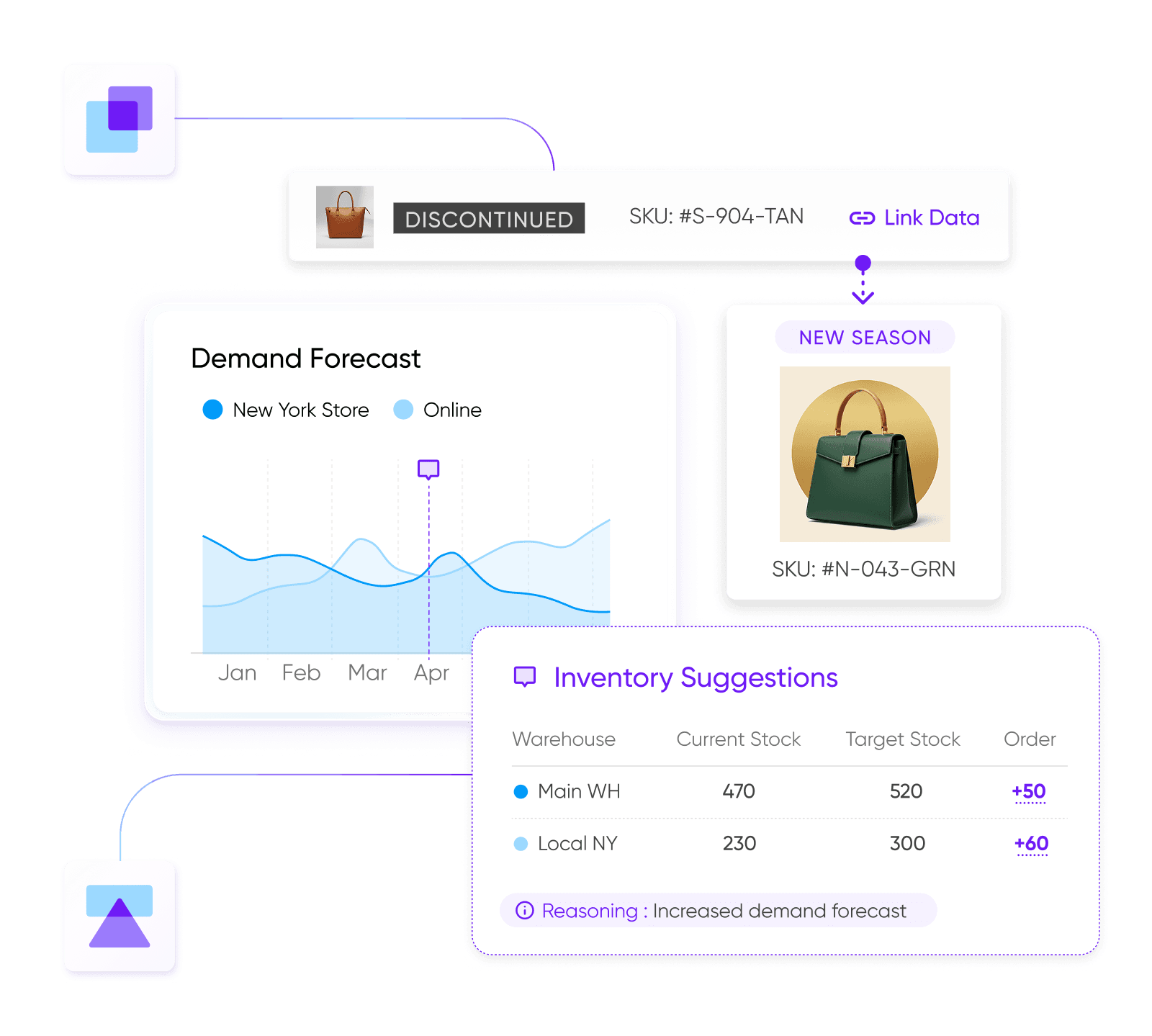
Algorithmic Forecasting: Tightly's forecasting engine runs competitive backtests to assign the perfect mathematical model to each item—for example, using ARIMA for a steady, evergreen skincare lotion, or Prophet for a highly volatile, seasonal holiday makeup palette.
Insight to Action: More importantly, Tightly IQ is a true decision intelligence layer. It does not just show you the data; it connects the insight directly to execution by proactively pairing the chart with suggested actions, such as immediately replenishing a trending lipstick shade or repricing an underperforming item. This allows brands to capitalize on hype or pivot strategies in seconds without manual digging.
Capital Quadrants: Tightly helps modern retail brands classify their catalog into clear "Capital Quadrants" (Winners, Traffic, Sleepers, Bleeders) so business owners know exactly where to invest their cash for maximum profit.
→ RELEX Solutions: Ideal Grocery, Fresh Food, and Big Box Retail

Poppi grape prebiotic soda can with condensation, surrounded by fresh lemons and limes. (Source: drinkpoppi.com)
While Tightly handles the fast-paced e-commerce world, RELEX Solutions is the go-to platform for retail operations dealing with grocery, convenience stores, and consumer packaged goods (CPG).
Key tools and how they help this industry:
No-Code Configuration: This allows for a much faster deployment and "time to value" compared to traditional enterprise software, as it can be adapted to unique business needs without heavy custom coding.
Machine-Learning Demand Sensing: RELEX captures hundreds of demand-influencing factors to adjust forecasts in real time. For example, it seamlessly integrates local weather data to anticipate short-term shifts in consumer behaviour, and automatically detects promotional cannibalization (when a promotion on one item hurts the sales of another) to refine forecasts and prevent overstocking.
Space & Planogram Optimization: Physical retail is strictly constrained by shelf space. RELEX links replenishment directly to store floor planning. It uses "direct-to-shelf replenishment" to ensure that the goods delivered perfectly fit on the store shelves, which minimizes handling costs and reduces the need for cluttered backroom storage.
Store Support AI Agent: This mobile agent empowers store-level teams to troubleshoot orders and resolve issues independently, reducing the burden on central support.
Retail Connected Planning for Manufacturers: This tool bridges the massive visibility gap between manufacturers and retail shelves. It integrates retailer Point of Sale (POS), inventory, and promotional data directly into the manufacturer's planning platform. This allows manufacturers to see what is actually selling at the store level, reducing out-of-stocks, cutting delivery penalties, and automating replenishment.
→ o9 Solutions: The Digital Brain for Heavy Industry
Now, let us step away from retail entirely. What if you build cars, manage telecommunications infrastructure, or manufacture aerospace equipment? That is where o9 Solutions steps in. o9 is a platform designed for automotive, life sciences, high-tech manufacturing, and energy industries.

Technician performs quality checks on the new Mercedes-Benz CLA, the first vehicle to integrate the Mercedes-Benz Operating System (MB.OS) at scale. (Source: mercedes-benz.com)
Key tools and how they help this industry:
Enterprise Knowledge Graph (EKG): The EKG is the "memory and logic" of the platform. It is not a standard database; it is a map of all relationships and constraints across demand, supply, and finance, creating a true Digital Twin of the Enterprise.
Touchless Demand Forecasting (Model Tournaments): Similar to Tightly, O9 rather than relying on a single algorithm, o9 runs continuous "model tournaments" combining statistical models, gradient-boosted trees, and deep learning to select the best forecasting approach as market patterns evolve.
Multi-Tier Supplier Risk Management: Complex manufacturers cannot just look at their direct suppliers. o9 maps Tier 2 and Tier 3 supplier relationships so organisations can identify deep upstream constraints—such as a shortage of a specific raw material or tariff exposures on sub-components—and pivot sourcing strategies before production lines are impacted.
Advanced Scenario Planning Engine: This tool enables Integrated Business Planning (IBP) by allowing cross-functional executive teams to simulate alternative futures side-by-side. If a global disruption occurs, the engine translates the external event into concrete supply chain impacts, showing executives exactly how it will affect lead times, capacity, costs, and overall corporate margins.
Conclusion
If you look at lists of top demand planning software, you might see these names grouped. But comparing them directly is like comparing a sports car, a tractor, and a cargo ship. They all move things, but they serve different purposes.
Choose Tightly if you are a high-scale retail brand that needs to align budget capital to daily inventory and act fast on sales trends with a hybrid "produce and buy" model.
Choose RELEX if your margins are tied to freshness, and you require the speed of no-code configuration to solve store-level execution and spoilage challenges.
Choose o9 Solutions if your organization operates in a non-retail sector and requires a centralized system to track complex interdependencies across various functional departments.
References
Mercedes-Benz. (n.d.). Luxury and commercial vehicles. Retrieved April 21, 2026, from https://www.mercedes-benz.com/
o9 Solutions. Enterprise AI software platform for planning and decision-making. Retrieved April 21, 2026, from https://o9solutions.com/
Poppi. Prebiotic soda for a healthy gut. Retrieved April 21, 2026, from https://drinkpoppi.com/
RELEX Solutions. Supply chain and retail planning platform. Retrieved April 21, 2026, from https://www.relexsolutions.com/
Rhode Skin. Curated skincare essentials. Retrieved April 21, 2026, from https://www.rhodeskin.com/
Tightly. System of intelligence for inventory excellence. Retrieved April 21, 2026, from https://tightly.io/
Laura B
Marketing Analyst
Share