Many scaling retail and direct-to-consumer (DTC) brands mistakenly believe that a world-class Enterprise Resource Planning (ERP) platform solves all their inventory and planning challenges. While platforms like SAP S/4HANA provide unparalleled transactional and financial control, they are not designed to be modern, agile inventory planning platforms.
This article explores the fundamental differences between SAP's transactional foundation and a decision intelligence layer like Tightly. It also explains why scaling brands achieve the best results by using both systems together.
What is SAP Inventory Management?
In SAP S/4HANA, Inventory Management (IM) is a core component of the Materials Management (MM) module. It helps businesses efficiently record, monitor, and manage stock movements across procurement, production, sales, and warehouse operations. It relies on real-time analytics and an in-memory database to offer faster processing and better visibility.
Like many top-tier ERPs, SAP is built for massive standardization, control, and heavy industry tracking. However, many supply chain managers find that ERPs are not always optimized for the highly agile, automated workflows required by scaling direct-to-consumer (DTC) or modern hybrid retail brands.
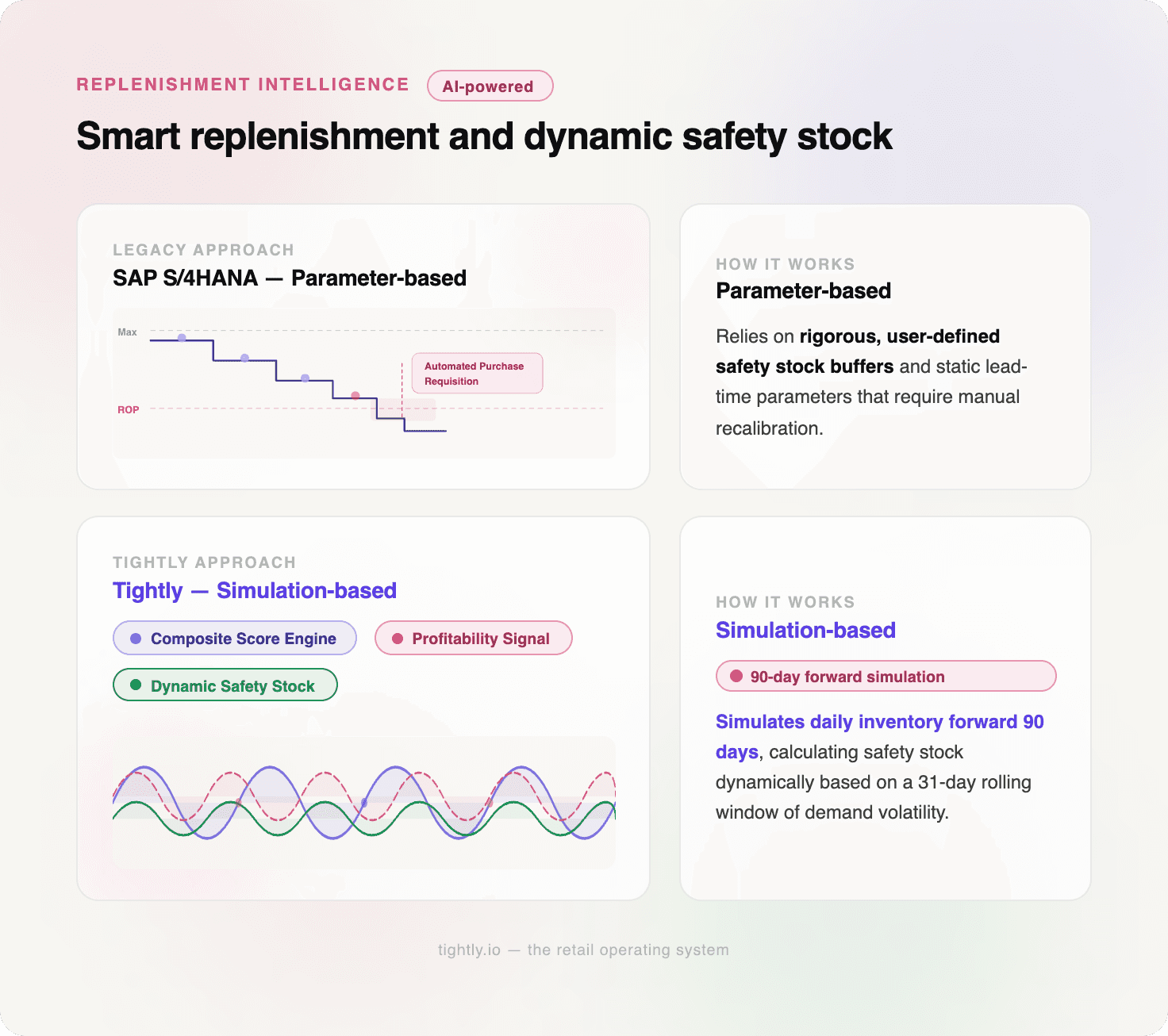
When you plug in a platform like Tightly, you gain a decision intelligence layer that supplements SAP’s execution power with automated inventory parameter calculations, GA4 website traffic integration, and advanced algorithmic forecasting
Understanding the Core Differences: Record vs. Predict
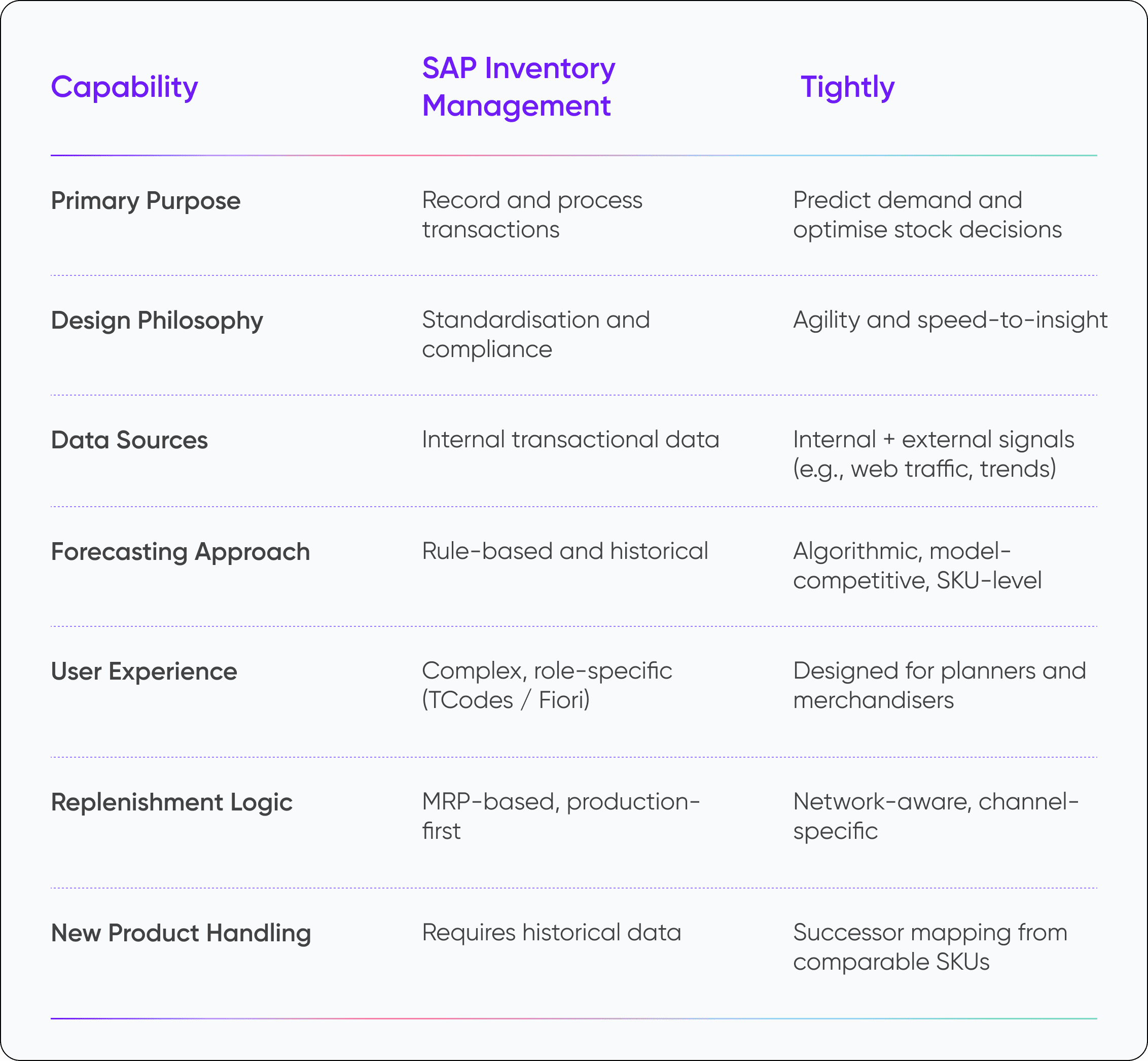
Before assuming an ERP handles all inventory tasks, it is critical to understand the difference between transactional inventory modules and purpose-built planning systems.
The Strengths of SAP Inventory Management
SAP's Materials Management (MM) and Extended Warehouse Management (EWM) modules are world-class for a reason. When it comes to transactional rigour and compliance, SAP provides:
Real-time stock visibility: Track inventory levels across multiple warehouses and bin locations with accuracy.
Goods movement processing: Automate and record goods receipts, transfers, issues, and returns.
Traceability: Manage high-value goods, track serial numbers, and monitor expiration dates.
Financial integration: Every movement automatically updates financial accounts and production schedules, requiring no manual reconciliation.
Where the ERP Reaches Its Limit
For manufacturers and regulated supply chains, these capabilities are essential. However, the ERP is primarily a ledger that tells you what has happened rather than what should happen next.
The core distinction: SAP tells you what your inventory position is and processes the orders you raise. Tightly tells you which orders to raise, in what quantity, through which channel, and why — before a stockout or an overstock forces your hand. |
The Planning Gap: Why Modern Retail Needs More
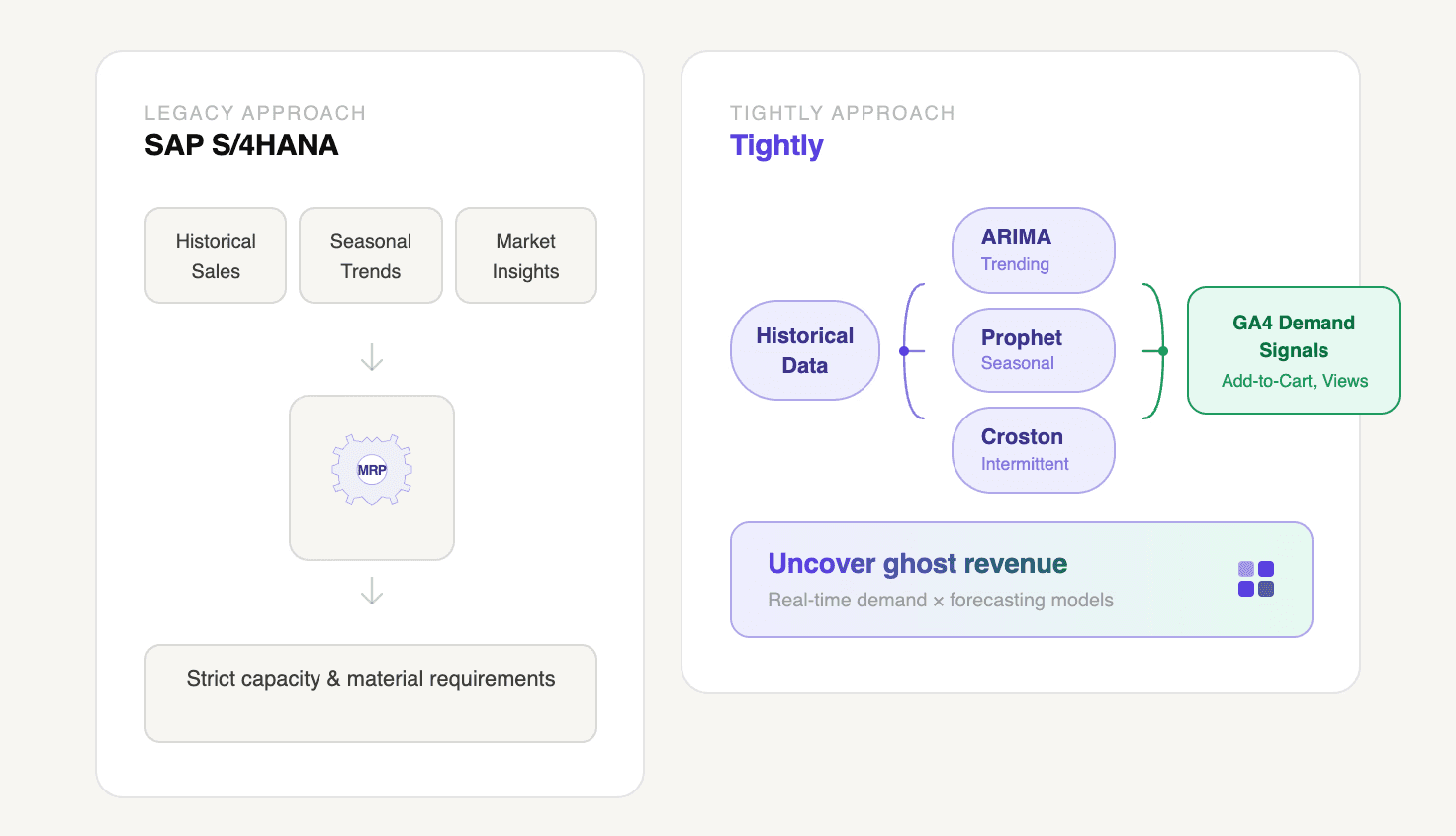
Modern retail environments are volatile, trend-driven, and highly fragmented compared to traditional manufacturing. SAP's inventory engine relies primarily on internal historical data and uniform statistical rules. Scaling brands often struggle with:
Volatile catalogues: Managing seasonal variants and new product launches without historical data.
Missed external signals: An inability to read live website traffic, social media trends, or customer search behaviour.
Apparel size complexity: Forecasting at the strict SKU level, leading to imbalances where certain sizes overstock while others sell out.
What Tightly Adds: The Decision Intelligence Layer
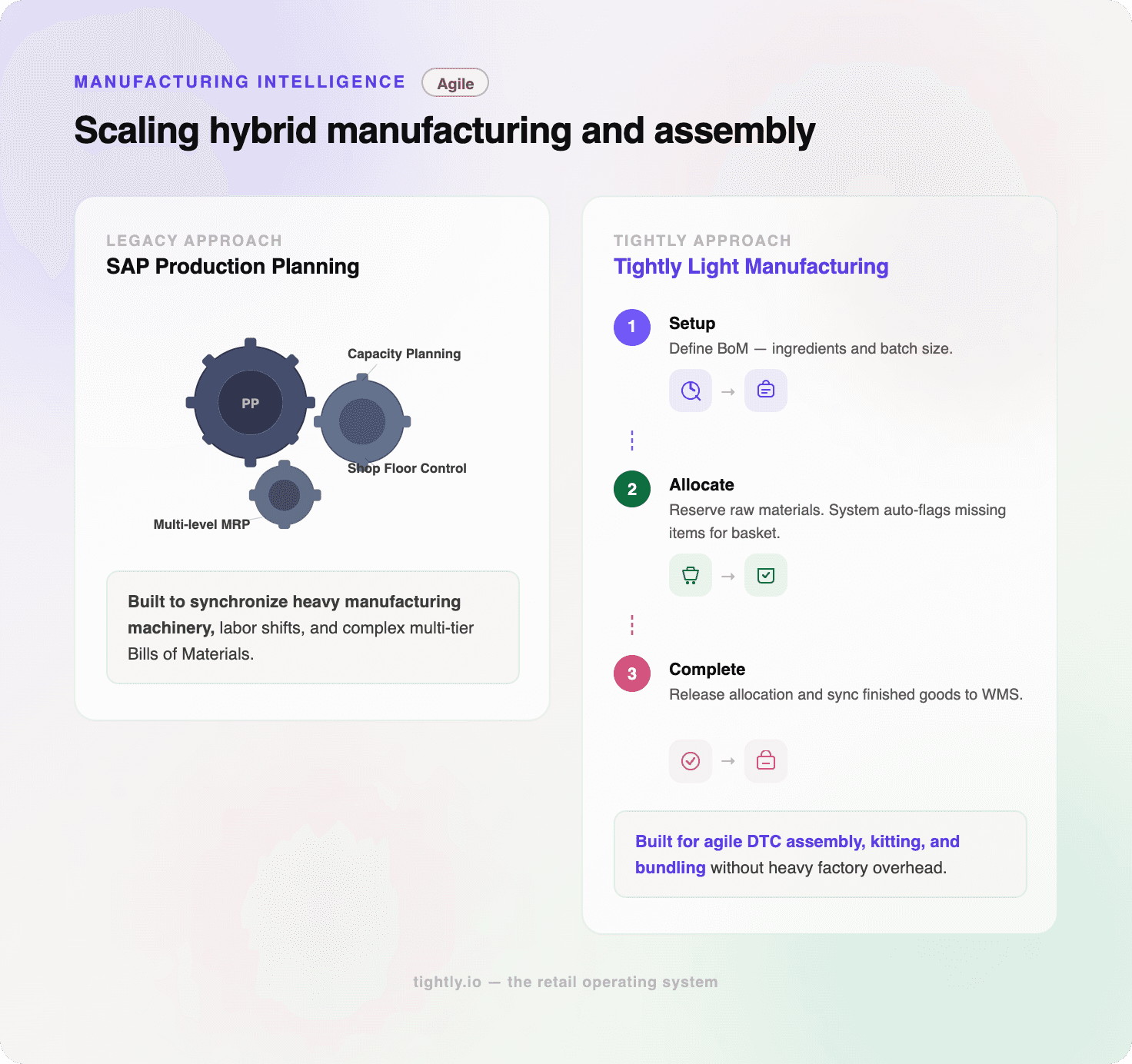
Tightly does not replace SAP's execution power. Instead, it sits on top as an intelligent planning engine, ingesting data from SAP and using advanced decision logic to improve purchasing and replenishment decisions.
Key Features of Tightly
GA4 Demand Signal Integration: Tightly connects to Google Analytics 4 to identify Ghost Revenue (lost revenue due to stockouts of heavily searched products) and spot cooling trends before they impact sales data.
Competitive Algorithmic Forecasting: Instead of applying one statistical method to the whole catalogue, Tightly backtests multiple models (e.g., ARIMA, Prophet, Croston) and selects the most accurate mathematical model for each specific SKU.
Size-Curve Logic: The platform aggregates demand at the parent-product level and distributes it to individual sizes using dynamic sell-through curves, keeping size runs intact.
Successor Mapping: For new product launches, planners can map to an older, similar predecessor, allowing the algorithm to inherit proven demand history instead of starting from scratch.
Capital Quadrant Analysis: Products are automatically classified into four actionable categories—Winners, Traffic Drivers, Sleepers, and Bleeders—helping you optimize working capital.
Plain-English Querying: With Tightly IQ, planners and executives can ask questions in plain English to get immediate, actionable insights.
The Ideal Inventory Stack: SAP + Tightly Working Together
The most effective modern retail approach is not about choosing between an ERP and a modern SaaS planning platform—it is about combining both for maximum commercial impact:
SAP acts as the Transactional Engine: Purchasing and inventory data are processed, and financials are updated.
Tightly acts as the Planning Brain: Demand is forecast, capital is allocated intelligently, and replenishment needs are calculated.
Together, this ecosystem allows modern DTC and omnichannel retailers to stop simply reacting to inventory imbalances and instead anticipate demand.
FAQs
Does Tightly replace SAP?
No. Tightly is an inventory planning and demand forecasting platform that integrates with SAP and other ERPs. It does not replicate transaction processing, financial accounting, or warehouse management. It adds the demand intelligence and automated replenishment layer that ERPs do not natively provide.
What makes Tightly's demand forecasting different from SAP's native forecasting?
SAP's MRP applies rule-based logic derived from production schedules and historical orders. Tightly uses algorithmic backtesting — running ARIMA, Prophet, and Croston (TSB) models head-to-head on actual SKU data and selecting the most accurate model per product. It also incorporates live GA4 web traffic, which SAP has no visibility of.
How does Tightly handle new product launches with no sales history?
Through Successor Mapping. A new SKU is linked to a comparable predecessor, inheriting its demand history and forecast data. This gives planners a statistically informed initial allocation rather than a blank slate, reducing the manual effort and error that typically accompanies new product introductions in ERP-driven workflows.
References
CertLibrary. (n.d.). A comprehensive guide to SAP ERP modules and their applications [Blog Post]. CertLibrary Blog.
Ingold. (2025). A guide to the SAP Business One inventory module [Blog Post]. Ingold Solutions.
Prometheus Group. (n.d.). SAP ERP: A comprehensive guide [Web Page]. Prometheus Group.
SAP. (n.d.). Enterprise resource planning [Web Page]. SAP.
SAP. (2024). What is inventory management? [Web Page]. SAP.
SAP. (n.d.). Functions of SAP inventory manager [Help Portal Documentation]. SAP Help Portal.
Stross, J. (2025). SAP modules list | A comprehensive guide for 2025 [Blog Post]. Pathlock.
Laura B
Marketing Analyst
Share