Back
Talking to Your Data - The AI Copilot Era for Inventory and Supply Chain
Laura B
Marketing Analyst
The next leap in ops productivity won't come from another dashboard. It will come from the end of dashboards as the primary way you make decisions — and the rise of the AI copilot for inventory and supply chain as the layer that replaces them.
If you lead inventory, supply, or merchandising at a growing brand, your week probably looks something like this: pull the demand report Monday morning, cross-check against current inventory in another system, message a supplier about lead times in a third tool, then build a one-off Excel to model the trade-off. Decision time: Wednesday. Maybe Thursday.
This is how a senior supply & demand planner at a mid-market brand described it to us recently:
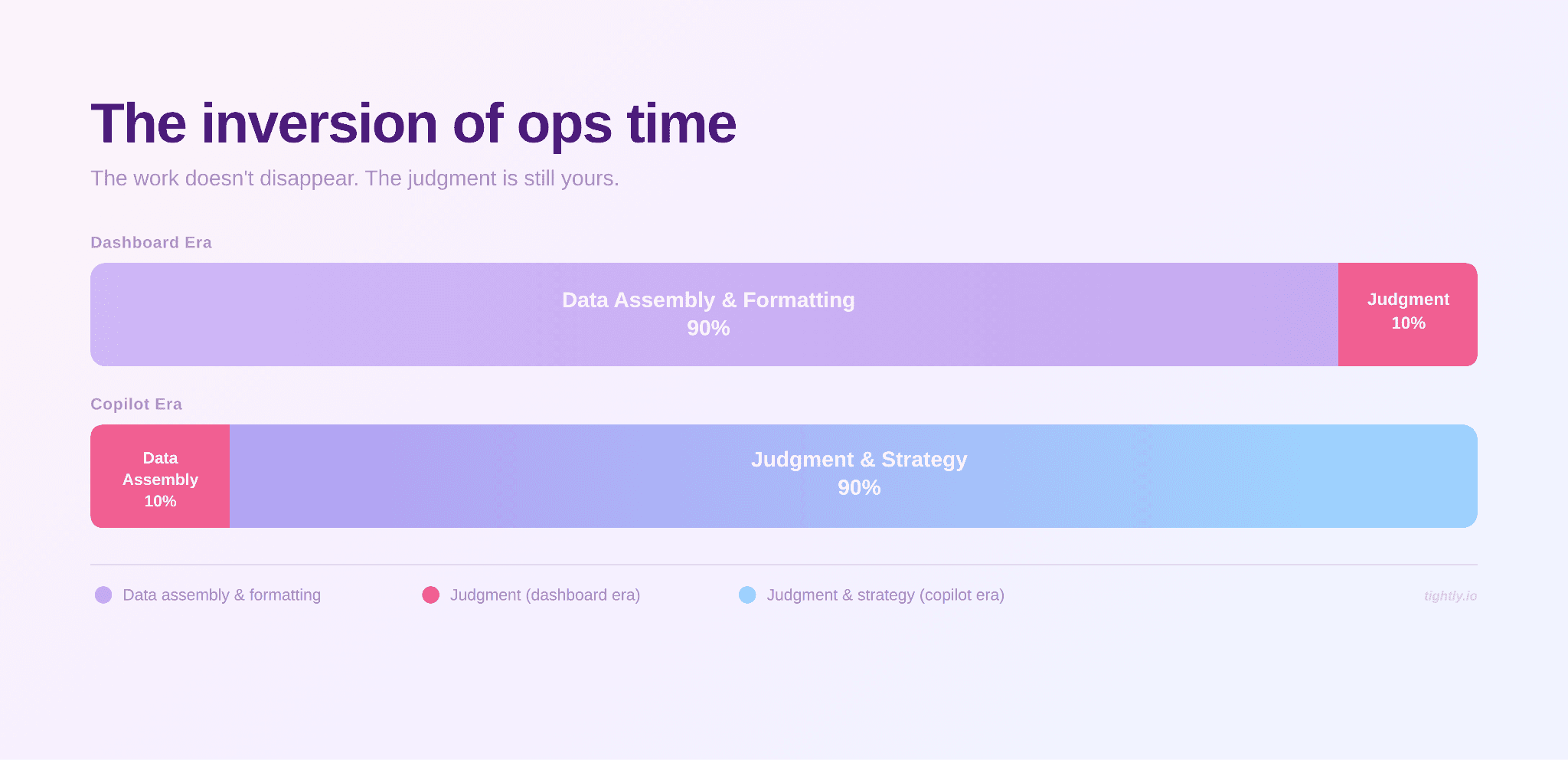
"I spend all my time building the information, and the other half trying to actually analyze it."
This pattern isn't an outlier. It's the rule across mid-market ops — and after a decade of "more dashboards, more BI tools," it's still the rule. Why?
Dashboards solved a different problem
Dashboards solved visibility. They never solved decision-making. The dashboard era — Looker, Tableau, Power BI, every embedded chart in every SaaS app — gave ops teams visibility into inventory levels, sell-through, supplier OTIF, and aged stock. The data was there. The view was there.
What dashboards didn't solve: the time between seeing a number and deciding what to do about it.
That gap — between visibility and decision — is where ops teams lose hours every day. Supply chain decision-making requires connecting data across multiple systems your dashboards don't talk to. It requires modeling trade-offs no one built a chart for. It requires answers to questions you didn't know to ask in advance.
The result: more dashboards, same delay. The chart is fast. The decision still takes three days.
We made the case for the underlying habit shift in our earlier piece on conversational analytics — moving ops leaders from passive consumption of static reports to active reasoning over live data. What we want to do here is go one layer deeper, into the infrastructure that finally makes that habit possible.
Why now: a new layer is being built across your tools
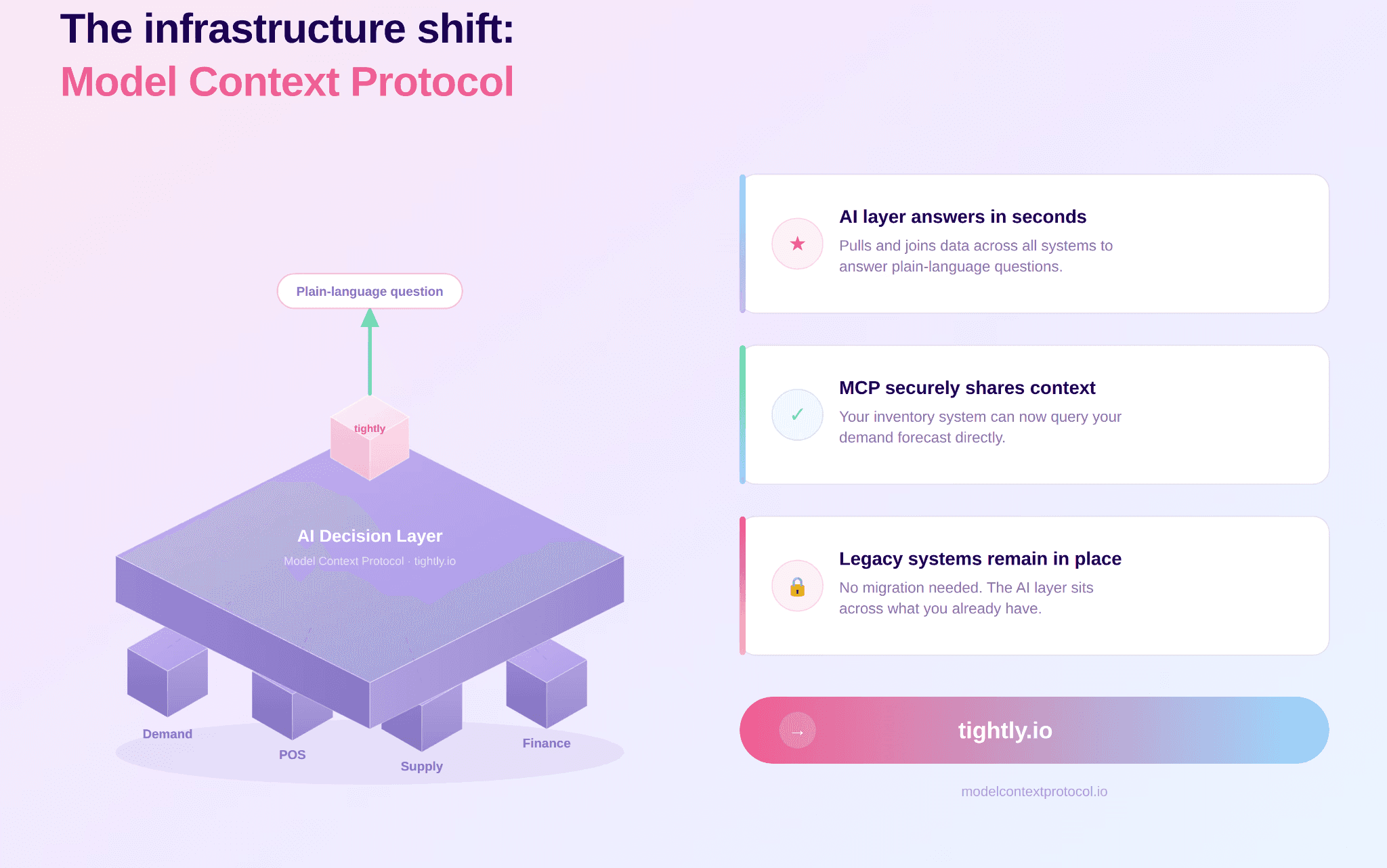
A new generation of AI protocols is letting tools share context with each other for the first time. The most prominent is the Model Context Protocol (MCP). In plain language: your inventory system can ask your demand forecast a question. Your supplier data can be cross-referenced with your finance system without anyone exporting a CSV. Your POS sell-through can be read in the same query as your supplier OTIF.
This sounds like infrastructure. It is. But the user-facing consequence is significant: you are no longer the integration layer. You are no longer the human moving information between tools so a decision can happen.
Instead, an AI layer sits across your systems and answers questions in plain language — pulling from wherever it needs to, in seconds, with the same data you'd see if you opened every dashboard manually. This is what makes a true AI copilot for inventory and supply chain different from yet another BI tool with a chat box bolted on.
The dashboard becomes the receipt of your decision, not the path to it.
What an AI copilot looks like in practice
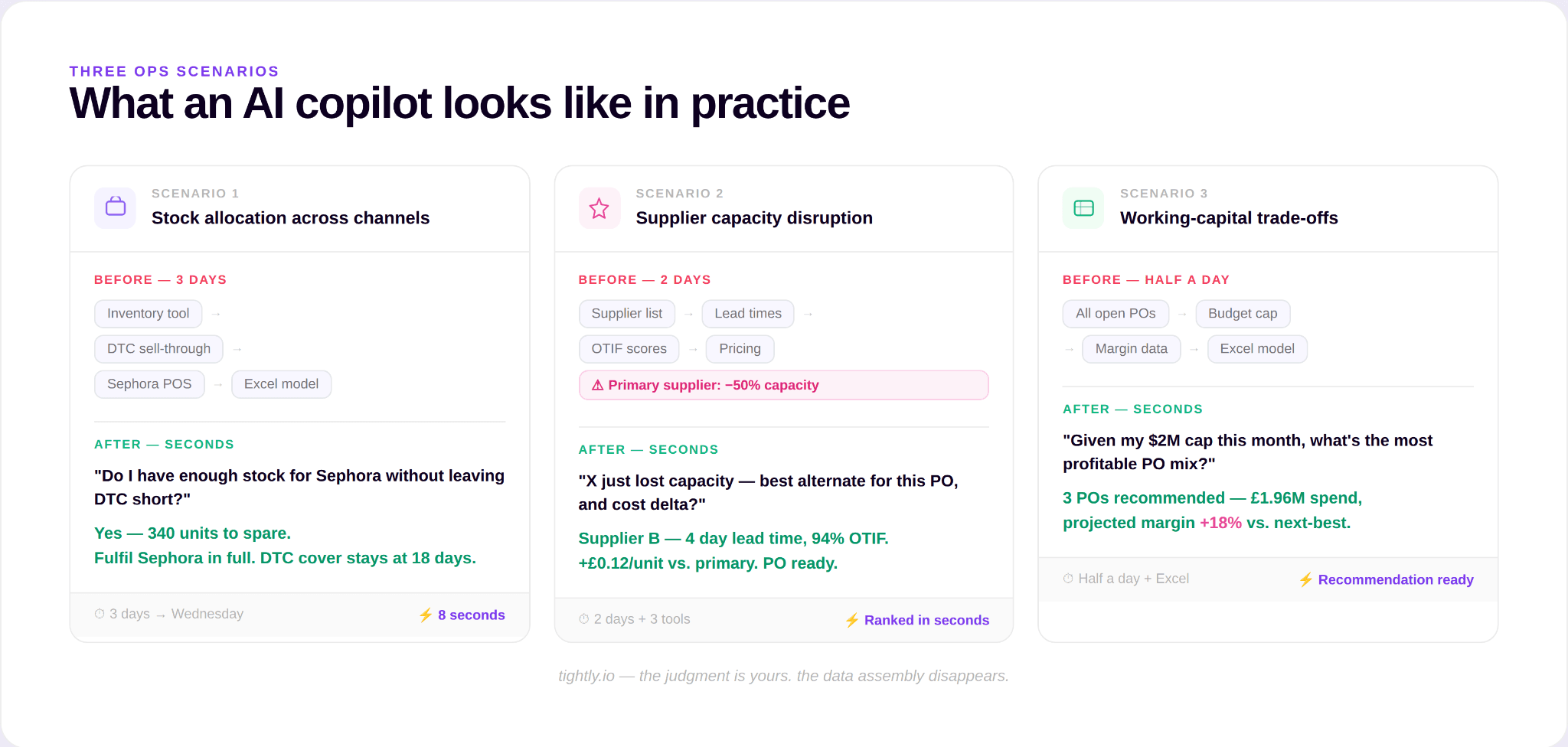
An AI copilot for inventory and supply chain handles the questions that used to take hours of manual cross-system work. Three concrete ops scenarios, before and after.
Stock allocation across channels
Before: open inventory tool, pull DTC sell-through, pull Sephora's POS data, model how much to ringfence for wholesale, decide.
After: ask — "Do I have enough stock for Sephora's next order without leaving DTC short?" Get an answer that crossed all four systems, with the recommendation explained.
Supplier capacity disruption
Before: a primary supplier loses 50% capacity. Pull alternate-supplier list. Cross-check lead times, OTIF, pricing. Decide. Open PO. After: ask — "X just lost capacity — who's my best alternate for this PO, and what's the cost delta?" Get a ranked answer in seconds.
Working-capital trade-offs
Before: build an Excel that models every PO option against the budget cap.
After: ask — "Given my $2M cap this month, what's the most profitable mix of POs to open?" Get the recommendation, ranked.
The work doesn't disappear. The judgment is still yours. What disappears is the manual gathering, re-formatting, and joining of data so the judgment can happen.
This is happening now
This shift isn't theoretical, and it isn't five years out. It's happening now, and at Tightly, we've spent the last several months building for it.
In one week, we'll show you what ops work looks like when you stop reading dashboards and start asking questions.
Until then, here's a question worth sitting with:
How many of your decisions this week could have been a single sentence?
FAQs
What is an AI copilot for inventory and supply chain?
An AI copilot for inventory and supply chain is a software layer that sits across the systems an ops team already uses — demand forecasting, inventory, replenishment, supply orders, supplier data, finance — and answers operational questions in plain language. Instead of pulling reports from each system separately, the user asks a single question and the copilot retrieves and joins the underlying data to produce a direct, decision-ready answer.
How is an AI copilot different from a BI dashboard?
A BI dashboard shows data; an AI copilot makes decisions easier. Dashboards visualize the data you knew to ask for in advance. An AI copilot answers questions you didn't know to ask, joins data across systems a dashboard can't reach, and explains the reasoning behind its recommendation. Dashboards are read; copilots are talked to.
What does the Model Context Protocol have to do with supply chain operations?
The Model Context Protocol (MCP) is an open standard that lets AI tools securely access data and capabilities from other software systems. For supply chain operations, MCP is the infrastructure that lets a single AI copilot pull from inventory, demand forecasting, supplier records, and finance systems in one query — instead of forcing the human to act as the integration layer between siloed tools.
Who benefits most from an AI copilot for supply chain operations?
Inventory planners, demand planners, purchasing managers, and heads of supply chain at mid-market and upper-mid-market retailers and B2B distributors benefit most. These roles spend the largest share of their day reconciling data across systems before they can make a decision. An AI copilot collapses that reconciliation work into seconds, so the human can focus on judgment instead of data assembly.
For more on the Model Context Protocol and how it's changing how software talks to software, see modelcontextprotocol.io.
Laura B
Marketing Analyst
Share