Back
Tightly vs Netsuite's Inventory Management Module
Laura B
Marketing Analyst
Let’s be honest: NetSuite is the gold standard for a reason. Their 2026.1 updates have moved the platform far beyond its origins as a digital filing cabinet for orders , turning it into a highly autonomous supply chain control tower. But for high-growth brands, "native" features can still feel a bit too basic for the level of complexity you're managing..While NetSuite remains the perfect System of Record, Tightly is the essential System of Intelligence required for inventory excellence.
1. The Evolution of NetSuite: From Visibility to AI
To understand why a dedicated planning tool is still necessary, one must look at NetSuite’s evolution:
The Visibility & Allocation Eras (Pre-2021): Focused on getting companies off spreadsheets and into unified multi-location tracking and intelligent supply allocation.
The Automation Era (2022-2023): Introduced Smart Count for live cycle counts and Ship Central to protect profit margins during fulfillment.
The AI & Predictive Era (2024-2026.1): The current cycle embeds deep intelligence, such as translating financial data into plain-language narratives and automating the purchasing lifecycle from request to supplier dispatch.
2. Market Radar: Tracking Competitors, Not Just Your Own Sales
While NetSuite looks inward at your past performance, Tightly looks outward at the entire market.
The NetSuite Limitation: Native replenishment is "reactive." It triggers a reorder because your stock hit a certain level based on your past sales. It doesn't know if a competitor just dropped their price or if a market-wide trend is about to spike demand.
→ The Tightly Advantage
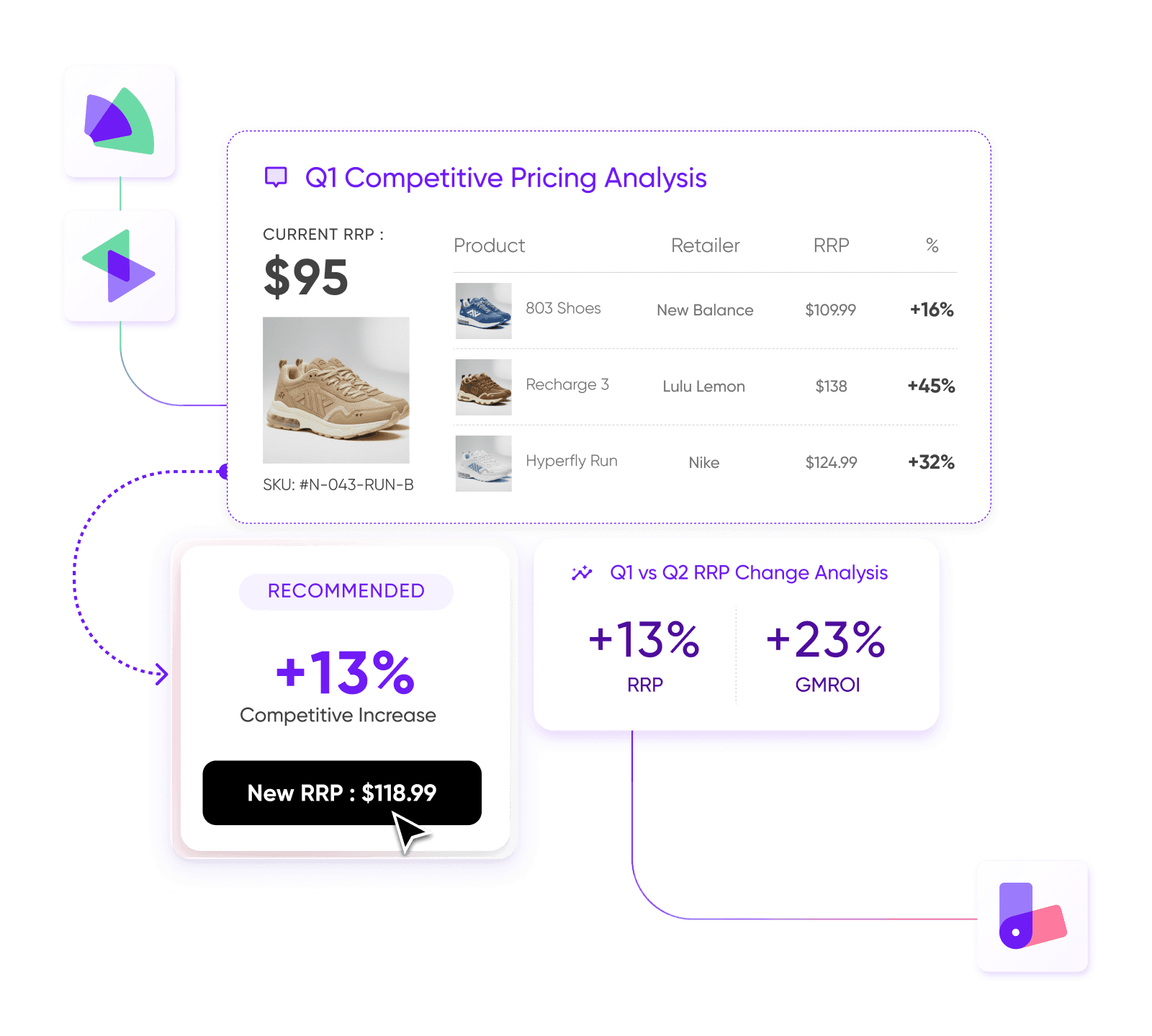
Tightly’s Market Radar ingests external signals—including competitor moves and traffic trends. If a competitor runs out of stock or changes their pricing, Tightly senses the shift in real-time and adjusts your inventory strategy before the demand even hits your site.
And beyond tracking competitors, Tightly integrates directly with Google Analytics 4 (GA4) to merge warehouse data with real-time website behavior. This allows you to catch out-of-stock items still receiving massive page views—and identify declining trends where web traffic has dropped by over 40% despite strong historical sales. By sensing these demand signals, you can scale cancel multi-million dollar purchase orders before the hype fades.
3. Advanced Forecasting: Machine Learning Tournaments
NetSuite’s demand planning relies on "Historical Math"—using linear regression or moving averages to project future sales.
Explainable AI: Tightly abandons static reorder points for Machine Learning Tournaments. Because every product has a unique sales pattern, Tightly runs a competitive "backtest" for every product, testing models like Prophet or AutoARIMA against a 13-week holdout period to assign the most accurate model automatically.
Simulating a Better History: Beyond just assigning the best forecast,,Tightly runs 90-day forward simulations for every product-location combination. It maps actual results against an "optimized scenario" to show how much trapped capital you could reclaim by turning stock faster.
Unlike static legacy systems, this approach connects advanced predictive mathematics directly to your bottom line, replacing operational guesswork with actionable financial foresight.
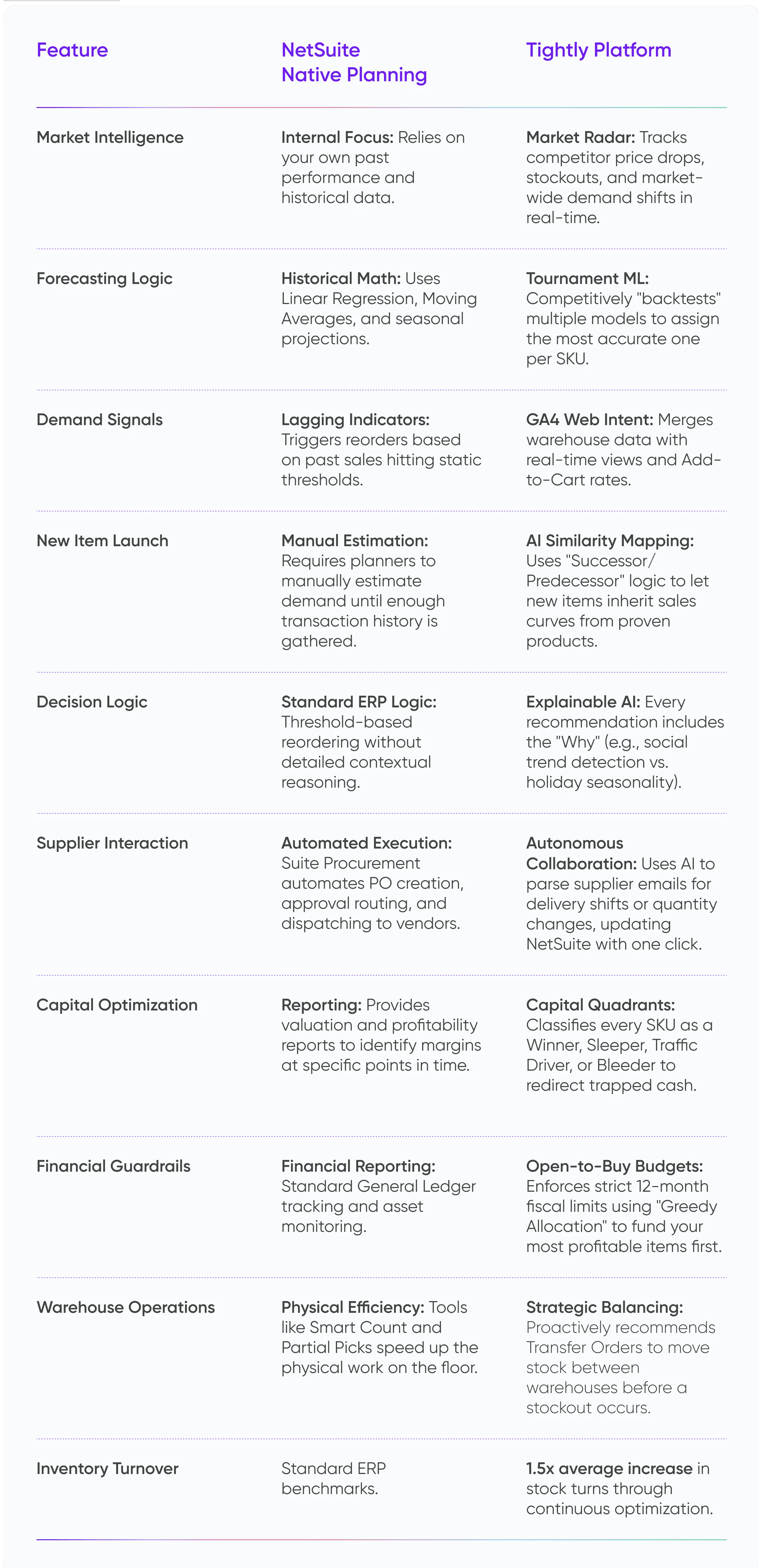
4. Feature Breakdown: Tightly Platform vs. NetSuite Native
5. Data-Driven Financial Impact
22% Uplift in Full-Price Sell-Through: Avoid "panic discounts" by using market signals to adjust stock.
23% Reduction in Inventory Holdings: Capital Quadrants classify SKUs (Winners, Sleepers, Bleeders) to prevent over-investing in stagnant stock.
57% Time Savings: Automating the "what, when, and why" through our Sourcing & Buying Software, which powers the Basket workflow and AI Supplier Collaboration.
Conclusion: Better Together
Inventory distortion is a $1.77 trillion global crisis. According to the IHL Group, "Shelf Empty" scenarios alone cost $707.4 billion because legacy systems miss the latent demand driving traffic to out-of-stock pages.
Solving this requires a holistic tech stack.
The Verdict: Use NetSuite for what it does best—reliable financials and warehouse execution—and supercharge it with Tightly for the world’s most advanced predictive intelligence.
References
Industry Research & Market Analysis
IHL Group. (2023). Retail Inventory Crisis Persists Despite $172 Billion in Improvements: Data on the Global Cost of Inventory Distortion. This study quantifies the $1.77 trillion global impact of inventory mismanagement, specifically highlighting the "Shelf Empty" crisis.
Official Corporate Documentation & Technical Specifications
Oracle NetSuite. (n.d.). Enterprise Resource Planning (ERP) Overview. Provides the foundational architecture for the NetSuite Cloud ERP system.
Oracle NetSuite. (2011). NetSuite Expands Cloud-Based Inventory Management with New Demand Planning [Press release]. Details the initial integration of demand forecasting within the native NetSuite environment.
Oracle Help Center. (2026). NetSuite Online Help & Release 2026.1 Guidelines. Documentation covering the latest functional updates, including "Smart Count," "Partial Picks," and AI-driven automated purchasing workflows.
Expert Commentaries & Technical Integration Guides
FinanSys. (n.d.). A Brief History of NetSuite. A longitudinal study of NetSuite’s evolution from an accounting tool to a comprehensive operational system.
Smash ICT. (n.d.). Things You Need to Know About NetSuite Releases. Analysis of the biannual update cycle and its impact on supply chain stability.
Comparative Software Analysis
Tightly Research. (2026). Best Supply Chain Intelligence Platforms for Enterprise Retail: Tightly vs. StockIQ. A comparative framework evaluating "Tournament ML" forecasting against traditional "Hierarchical" planning models.
Laura B
Marketing Analyst
Share