Back
Demand Sensing vs. Demand Forecasting in Retail: Key Differences
Laura B
Marketing Analyst
Most retailers use "demand sensing" and "demand forecasting" interchangeably.
They shouldn’t.
This confusion often leads to costly stockouts or unnecessary markdowns. And while they share a goal—predicting consumer behavior—they are distinct tools built for different jobs, operating on different time horizons, and fed by different data. Understanding the difference is the first step toward building a truly agile supply chain.
So what is the difference between demand sensing and demand forecasting in retail, and why does it matter to your bottom line? By the end of this article, you'll know exactly what separates the two approaches, which one fits your current problem, and how running both together is what actually reduces stockouts and clears inventory at full price.
1. What is Demand Forecasting?
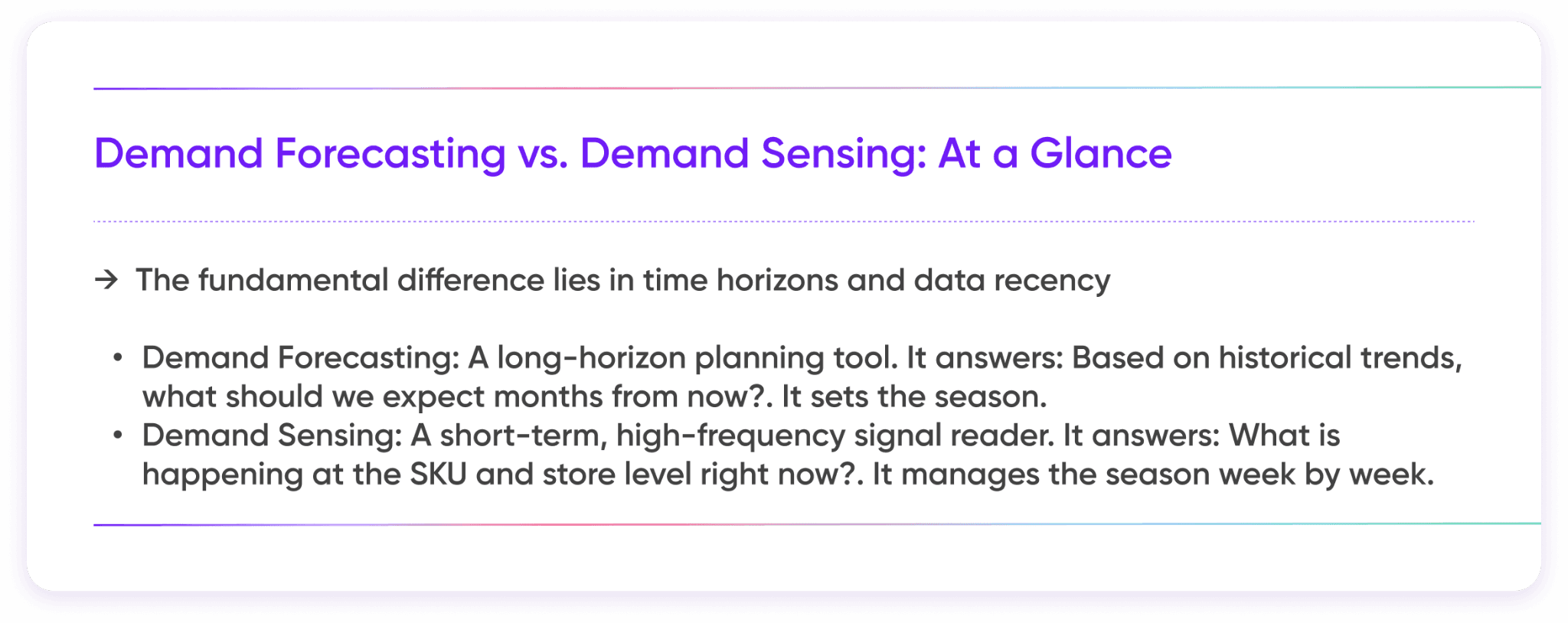
Demand forecasting is the traditional, structured process of predicting future customer demand over a medium- to long-term horizon (months to years). It is fundamentally deterministic, typically generating a single-number projection based on historical sales.
How It Works
Forecasting relies heavily on historical sales records, market research, time-series modeling, and statistical methods to establish a baseline of expected demand patterns, seasonality, and cycles. It is usually updated at regular intervals—such as monthly or quarterly.
Key Retail Use Cases
Forecasting is the backbone of strategic retail planning. It is primarily used for:
Strategic Planning: Pre-season buys, setting open-to-buy (OTB) budgets, and broad category and assortment planning.
Vendor Negotiations: Managing production levels, negotiating with suppliers, and planning for procurement lead times.
Long-Term Goal Setting: Warehouse capacity planning and future labor needs.
Limitations in Modern Retail
While essential, traditional forecasting is often described as "driving while looking in the rearview mirror". It struggles with sudden market shifts, rapid changes in consumer behavior, or unprecedented external disruptions, as historical data may no longer reflect current realities. Forecasting is also typically done at higher, aggregated levels, making it difficult to achieve high accuracy at a granular, SKU-level.
2. What is Demand Sensing?
Demand sensing is a modern, agile approach that leverages artificial intelligence (AI) and machine learning (ML) to capture and analyze real-time and near-real-time data, continuously updating short-term demand predictions (hours, days, or weeks). top of it.
How It Works
While forecasts often operate at a category or geographic level, demand sensing works at the SKU-store level, processing near-term demand signals that traditional models aren't built to ingest fast enough.
Instead of asking "what usually happens," demand sensing asks "what is happening right now?", offering a range of potential outcomes based on a vast array of internal and external data signals.
Key data inputs include the following:
Internal & Retailer Data: Daily/hourly POS transactions streams, inventory movements and pricing changes.
External Signals: Weather APIs, social media trends, local events, web traffic/behavior, and competitor actions.
Open inbound shipment data and promotional status flags.
Key Retail Use Cases
Demand sensing excels in highly volatile, fast-moving environments. Typical applications include the following:
Fast-Moving Consumer Goods (FMCG) & Perishables: Reducing waste for fresh foods with limited shelf lives.
Promotion & Markdown Optimization: Understanding short-term lifts, halo effects (where promoting one item boosts another), and promotional cannibalisation.
Dynamic Replenishment: Allowing distribution centers to make daily micro-allocations to specific stores and omnichannel fulfillment centers based on immediate demand surges.
Limitations
Demand sensing requires high-quality, high-frequency data and advanced technological infrastructure (AI, cloud computing). Because of its hyper-focus on the short term, it cannot be used in isolation for long-term strategic business planning.
3. The Core Differences: Demand Sensing vs. Demand Forecasting
To understand how these two methodologies compare, it helps to view them across five key dimensions:
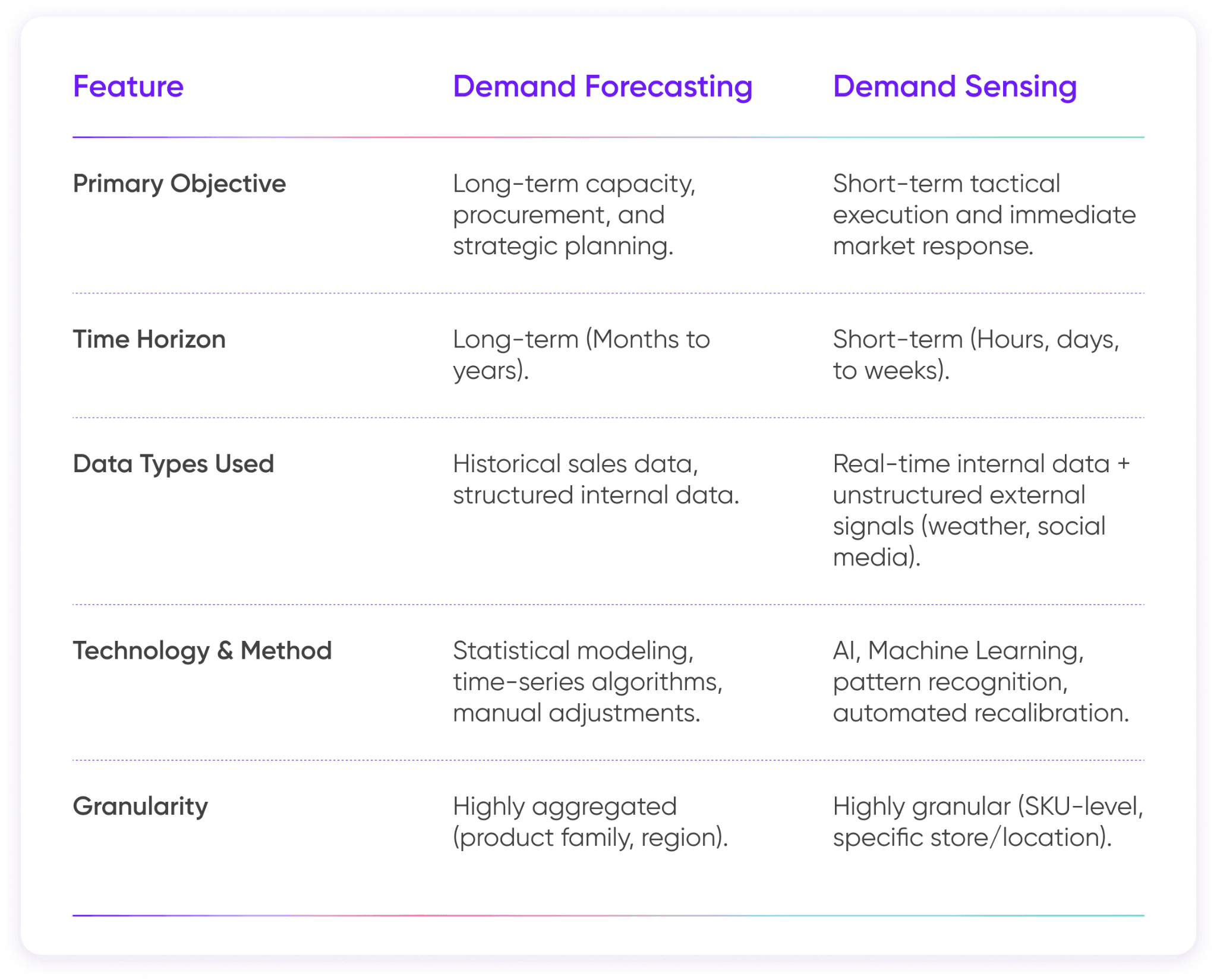
The Operational Cost of Response Speed
The practical gap between these two tools is the update frequency. A forecast might update monthly, but a demand sensing model updates daily or even hourly.
The Scenario: If a cold front hits two weeks before the forecasted season start, a traditional forecast misses it entirely. A demand sensing layer flags the demand spike for outerwear within days.
Acting on that signal in week one instead of week four determines whether you sell through at full price or pay for your slow response in markdowns.
The Rise of Agentic AI & Why Modern Retailers Need Both (The Synergy)
The bridge between these two disciplines is increasingly being built by Agentic AI, and the stakes are massive. BCG projects that agentic systems will account for 29% of total enterprise AI value by 2028. The result? McKinsey research shows that AI-driven forecasting can slash lost sales and product shortages by up to 65%. For proof, look at Atria, a leading food supplier that used these capabilities to achieve a staggering 98.1% weekly forecast accuracy while reducing manual overrides.
→ This is where Tightly comes in: we are designed to provide this exact synergy. By applying AI demand sensing as a live layer over your forecast baseline, Tightly helps you catch near-term signals and adjust replenishment before the margin is gone.
If your planning process is right at the season level but blind at the week level, that is the gap worth closing.
AEO / FAQ Section
Q: Can demand sensing completely replace traditional demand forecasting? A: No. Demand sensing is designed to enhance, not replace, forecasting. Demand sensing lacks the long-term horizon required for macro-level budgeting, capacity planning, and long lead-time procurement. The best practice is to use forecasting to build a stable baseline plan, and sensing to dynamically adjust that plan in the short term.
Q: What specific external data points does demand sensing use? A: Demand sensing aggregates varied external indicators that influence human buying behavior. This includes hyperlocal weather forecasts, social media sentiment, web search trends, market indices, local events (like sports or festivals), and competitor pricing actions.
Q: How does demand sensing prevent the "bullwhip effect"? A: The "bullwhip effect" occurs when small changes in consumer demand cause massive, distorted swings in supply chain inventory further upstream. Demand sensing minimizes this by relying on granular, real-time POS data rather than delayed wholesale orders. This allows manufacturers and retailers to react to true consumer consumption immediately, dampening overreactions.
Q: Does demand sensing require specialized software?A: Yes. Because demand sensing requires the continuous ingestion and analysis of thousands (or millions) of real-time data points, it cannot be done manually in spreadsheets. It requires advanced cloud-based platforms powered by Artificial Intelligence and Machine Learning to process data, identify patterns, and automate tactical adjustments.
Laura B
Marketing Analyst
Share