Back
The B2B Billing Wall: A Guide to SaaS Subscription Management
Laura B
Marketing Analyst
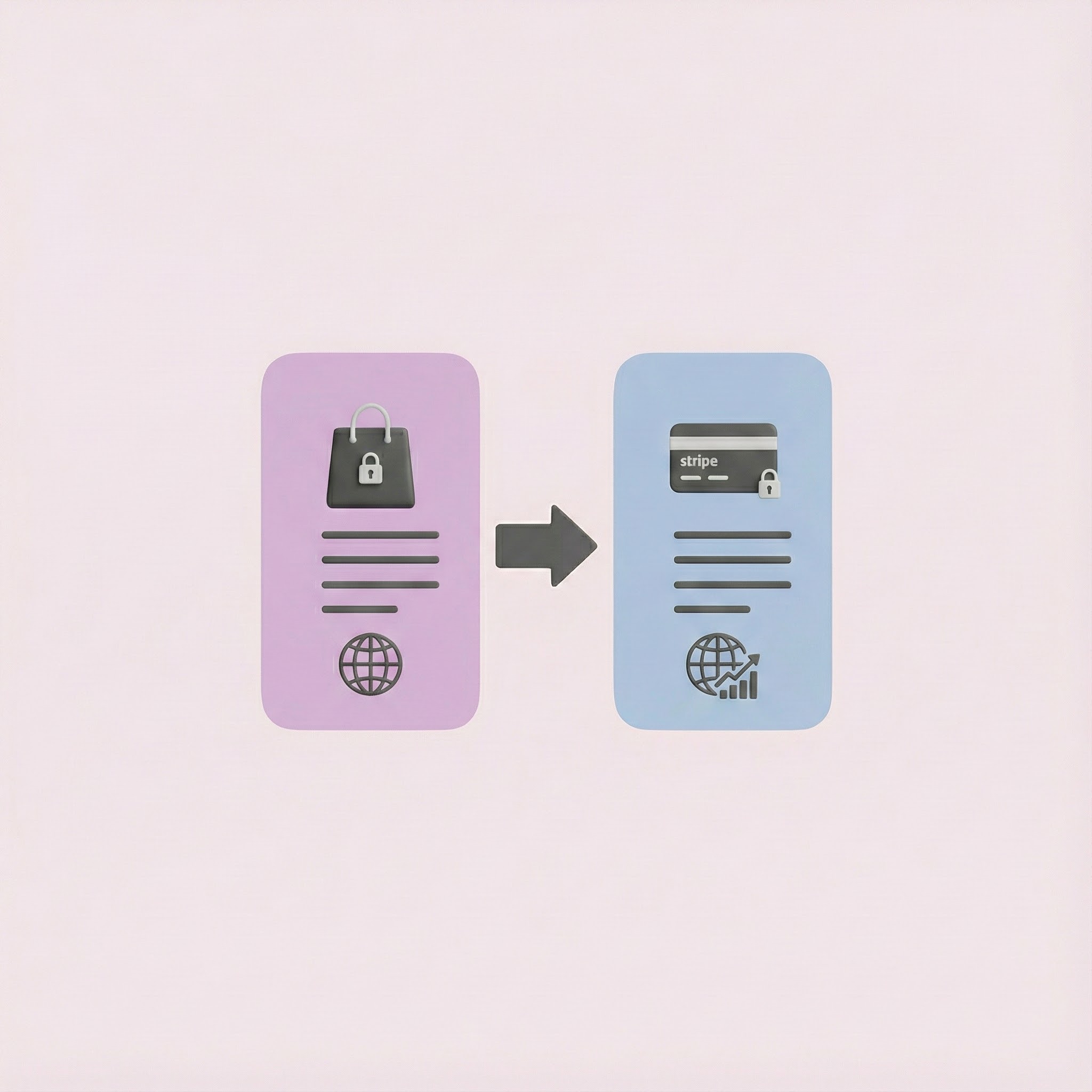
Understanding Shopify’s billing system
Think about the last time you bought a t-shirt online. You clicked, you paid, you were done. That's a simple, one-time purchase and Shopify is great at it.
But what if you're not selling t-shirts? What if you're trying to manage complex SaaS subscription management or sell 1,000 office chairs to a large corporation? It's a long, messy process that involves quotes, multiple departments, approvals, and a bill that might not get paid for two months. This is where we stumble onto Shopify’s Achilles Heel - its billing system was built for the t-shirt, not the office chairs. A t-shirt is bought instantly with a credit card, but businesses almost never do that. They expect to be billed later. It's called 'Net 30' or 'Net 60,' which is just business-speak for "Send us the stuff, and we'll pay the invoice in 30-60 days."
Shopify's checkout just wasn't built for that. It demands instant payment, which happens to be a deal-breaker for most big companies. Beyond this, Shopify also stumbles on how businesses actually operate. Real businesses need to track everything with a Purchase Order (PO) number, or their accounting team won't pay the bill. Shopify doesn't have a dedicated spot for this.
Then there's the fact that you're not selling to one person; you're selling to a whole team. A single company account might have 50 buyers, 5 managers who have to approve orders, and 3 different shipping addresses. Shopify is just built for a 'one person, one account' world and can't handle that kind of team structure.
And finally, in B2B, not everyone pays the same price. Partners might get a special discount, for example. It all comes down to this: Shopify's system is built around the cart. B2B is built around the relationship. This fundamental mismatch is why so many ambitious brands end up searching for Shopify app billing alternatives.
We Outgrew Shopify Billing. Here’s Why.
As Tightly grew and bigger brands wanted to work with us, we kept hitting a wall. These Shopify Billing limitations turned into an issue. As our platform began to scale, our market strategy also began to evolve beyond our initial model. We needed a billing architecture that could support more complex, enterprise-level contracts.
We found that Shopify's billing system, which is great for its core B2C e-commerce use case, presented some structural constraints for our specific B2B SaaS model:
→ Offering annual commitments that are billed in monthly installments.
Big companies want to sign a one-year contract but pay for it in monthly chunks.
→ Personalizing plans.
Our sales and success teams needed the autonomy to serve enterprise clients. This meant having the flexibility to manually provision custom plans, apply non-standard discounts, or make one-off adjustments (like extending a trial) that weren't tied to a public-facing plan.
→ Dependending on Shopify’s payment rules.
Because the billing was deeply coupled with the Shopify platform, it created operational difficulties in expanding our services to customers outside of the Shopify ecosystem. We needed a unified and flexible billing system that could serve all our users to get to the next level.
Finding The Right Option - What are the Alternatives for a SaaS Business?
Let's start with a basic 'must-know' for any online business: the difference between a 'Payment Gateway' and a 'Merchant of Record.' The main difference is just who is legally responsible for the transaction."
→ A Payment Gateway is like the credit card terminal in a retail store. It's a secure conduit that passes your customer's payment information to the bank. When you use a Payment Gateway, your business is the Merchant of Record. You are the legal seller, your company name is on the customer's credit card statement, and you are 100% responsible for all taxes, compliance, and liability.
→ A Merchant of Record (MOR) is like a department store (e.g., Nordstrom) that sells your product for you. They are the reseller. The customer pays Nordstrom, Nordstrom handles the sales tax, and then Nordstrom pays you.
Feature | Payment Gateway | Merchant of Record (e.g., Paddle) |
Legal Seller | You (your company) are the seller. | The MOR (e.g., Paddle) is the seller. |
Tax & VAT Liability | Your Responsibility. You must calculate, collect, file, and remit all taxes in every jurisdiction you sell to. | The MOR's Responsibility. This is their primary job and main value. |
Payment Card Industry (PCI) Compliance | Your Responsibility. Using a gateway's tools (like Stripe Elements) makes this much easier, but you are still the one legally responsible. | The MOR's Responsibility. You don't have to think about it. |
Fraud & Chargebacks | Your Responsibility. The gateway provides tools (like Stripe Radar), but you manage disputes and pay the chargeback fees. | The MOR's Responsibility. They typically handle and absorb these. |
Fees | Lower Per-Transaction Fee. (e.g., 2.9% + $0.30). But this does not include fees for tax software, fraud tools, etc. | Higher All-in-One Fee. (e.g., 5% - 10% + $0.50). This fee includes everything: processing, tax, compliance, and fraud. |
Customer Branding | Full Control. Checkout is on your domain. Your name is on the credit card statement. | Less Control. Checkout may be on their domain. Their name (or a co-branded name) is on the statement. |
Billing Support | Your Responsibility. All refund requests, billing questions, and "who charged me?" emails come to you. | The MOR's Responsibility. They handle all billing-related support. You only handle product support. |
Now that you know these technical terms, let us check the alternatives, which will depend on your primary need: lower fees, more global power, or outsourcing all the tax bureaucracy.
When you're looking for payment solutions, they happen to fall into three different groups, each solving a different problem.
1. Direct API-First Competitors.
Apart from the complex title, essentially these are all-in-one platforms that do the same fundamental job as Stripe. You'd typically look at these if your company is at a massive scale and you want to negotiate better pricing, or if you need a very specific feature, like Braintree's deep integration with PayPal.
→ Adyen is built for huge, global companies and can be a cost-saver if you have a very high sales volume. The trade-off is that it’s complex and not very friendly for a startup;
→ Braintree (which is owned by PayPal) is one of the original competitors. It's a reliable choice, and its main advantage is that it makes adding PayPal as a payment option incredibly simple. Its main downside is that it just doesn't feel like it innovates as fast or offers as many new tools as some other competitors.
→ Checkout.com is a fast-growing, newer player that's very popular in Europe and the Middle East. It feels a lot like Stripe and is often more flexible on its pricing to win your business. The catch is that its ecosystem is smaller, so you won't get all the extra add-on products (like advanced tax or reporting tools) that Stripe offers.
2. MOR Platforms
These aren't just payment processors; they act as a legal reseller for your software. Their main value is that they take on the full legal and financial liability for every sale. This is a huge benefit for businesses that want to sell globally, because the MOR handles all the complex, country-specific sales tax, fraud, and compliance, which is a massive headache to do yourself.
3. Subscription Management Platforms.
These are not payment processors. They are a specialized management layer that sits on top of a gateway like Stripe. You'd only need this if your company's billing logic becomes exceptionally complex—for instance, mixing all kinds of usage-based fees, per-seat plans, and one-time charges—and you've outgrown what Stripe's own billing tools can handle.
Who Should Use Which?
→ Stripe if you are a typical SaaS startup. You want to move fast, have the best developer tools and Stripe provides that as it is an all-in-one payment gateway and processor.
→ Go with a Merchant of Record if your biggest fear is global sales tax and compliance. You're willing to pay a higher percentage to have someone else solve that headache for you entirely.
→ Go with a Direct Competitor if you have extremely high volume (millions $/month) and want to negotiate a lower processing fee, or if you need specific global payment methods that Stripe doesn't offer.
→ Go with a Subscription Manager if your billing model is exceptionally complex, and you've already outgrown what Stripe Billing can do.
The Right Solution For Tightly
As previously discussed,we needed full control over our subscription logic—something our previous system couldn't offer. So we migrated our entire subscription system to Stripe Billing. Our decision was based on Stripe's reputation as a complete financial infrastructure platform, and we found out that its advantages for a scaling SaaS company like ours fell into three main categories:
1.Built by developers, for developers.
Its APIs are clean, logical, and famously well-documented. This meant our team could move fast, integrating complex payment flows in an afternoon instead of weeks. This flexibility extends to its core subscription logic. Stripe Billing is a powerful subscription management engine that was built to handle exactly the scenarios we couldn't. It manages everything from free trials and coupons to the complex logic of pro-rating a plan when a user upgrades mid-month. It also automatically handles the messy work of recovering failed payments.,
2. Complete ecosystem that scales with a business.
As our needs become more complex, we've found Stripe already has a product ready for us. If we need to handle enterprise-level invoices, there's Stripe Invoicing. For automated tax calculation, there's Stripe Tax. It also has global capabilities: can handle over 135 currencies and is able to deal with all the different local payment methods our international customers expect.
3.Handles all security and compliance burden.
By using Stripe's tools, sensitive card data never touches our servers, for example. This offloads almost all of that compliance burden from our team, allowing us to focus on our product instead of security audits.
What All this Means For Our Customers
So, why should you care? Because this switch to a flexible billing for SaaS model unlocks a ton of value.
→ Support for Annual Contracts
We can now offer annual commitments that are billed in monthly instalments. Want that 12-month contract with monthly payments? Done.
→ Custom Deal Structures
Our sales and success teams now have the autonomy to serve our clients more effectively. This means we can provide custom plans, apply specific pricing or discounts, and make one-off adjustments like extended trials. It allows us to tailor a solution to your specific needs.
→ Transparent Billing
We have also implemented friendlier plan logic. This includes "grace periods" to protect against service interruptions from minor overages, as well as proper pro-rated billing. When you upgrade, you will only be charged for the partial time you use the new plan, ensuring you never pay for more than you receive.
Who Benefits Most from This Change?
This move was a necessary strategic step, enabling true flexible billing for SaaS. This new system is designed specifically for:
→ Mid-market and enterprise D2C brands who have outgrown basic, rigid billing systems.
→ Customers who require real contracts and payment terms that align with their finance departments.
→ Ambitious brands looking for a solution that can actually grow with them.
A Note on Our App Store Status
To achieve this level of billing freedom, we did make the strategic decision to become "unlisted" on the Shopify App Store. We believe this was a necessary trade-off. It allows us to finally offer the powerful, enterprise-level billing and subscription management that our customers require for their own growth.
Laura B
Marketing Analyst
Share