Back
The 2026 Guide to Data-Driven Assortment Planning for D2C Brands
Laura B
Marketing Analyst
The "new product gamble
For anyone in retail or e-commerce, there is no moment quite like a new product launch, when you have to “gamble” on the success of a new SKU.For merchandisers and planners at modern D2C brands, the job is a demanding balancing act.
On one hand, you are responsible for the "safety" of your core bestsellers, whilst on the other hand, you are responsible for the new exciting styles that drive all the marketing buzz and attract new customers.
Your entire challenge is captured in assortment planning: the art of deciding what the collection will look like next season. This means answering a constant stream of difficult questions. How many brand-new styles should you add? How many new colorways of an existing bestseller? And then comes the most important question of all: how many of each should you buy?
This question is the core challenge of demand forecasting for new products. Every new product you add to the line isn't just a creative choice; it's a bet placed with real, significant capital. This is the moment a planner or merchandiser has to commit thousands of dollars to inventory for a product that has zero sales history. Whether it's a seasonal style, a new colorway, or a next-generation device, the new product introduction (NPI) is one of the highest-stakes bets a retailer can make as they are forced to place a massive bet solely based on a trend report.
The stakes are enormous:
→ The Hit (Stockouts) - If you guess too low and the product is a hit, you stock out in the first week. This is an absolute disaster. You've not only lost out on all that potential revenue, but you've frustrated new customers and, crucially, you've wasted the thousands of marketing dollars spent to drive traffic to a "Sold Out" page.
→ The Flop (Overstocking) - But if you guess too high and the product is a flop, you're in just as much trouble. Now your cash is trapped in a mountain of overstock that will clog your warehouse and drain your resources for months until it's finally clearanced.
In a fast-moving, competitive market, neither of these options is good enough. By the time you have enough historical data to make a decision, the critical launch window is often already closing, which inevitably leads to a cascade of costly and predictable problems.
And the core issue is that our modern, data-driven planning systems are brilliant at analyzing history. But a new, "blank slate" SKU has no history. This forces the entire team back to manual spreadsheets and guesswork, which is an unreliable way to run a business.
Managing the Full Product Lifecycle
Effective assortment planning, however, isn't just about adding new products. It is also about strategically and gracefully replacing old ones.
This is the other, more complex side of SKU lifecycle management, a process formally known as product supersession. At its simplest, this involves phasing out one product (like an old version) while seamlessly launching its replacement. The most famous example is the annual iPhone launch, where Apple must perfectly manage the "ramp-down" of the iPhone 14 as it simultaneously manages the "ramp-up" of the new iPhone 15.
When done correctly, the customer barely notices. But if that timing is wrong, the financial consequences can be disastrous. This "handoff" is actually a two-part forecasting problem, and both sides have to be timed perfectly.
1.First, you have the "ramp-down" of your old product. A final purchase order must be placed months in advance, begging the question: how many do you buy? You need to order just enough to last exactly until the new model arrives, but not a single unit more.
2.Second, you have the "ramp-up" challenge for the new one. This is the classic problem of forecasting without historical data, which, as we have discussed, is a massive gamble.
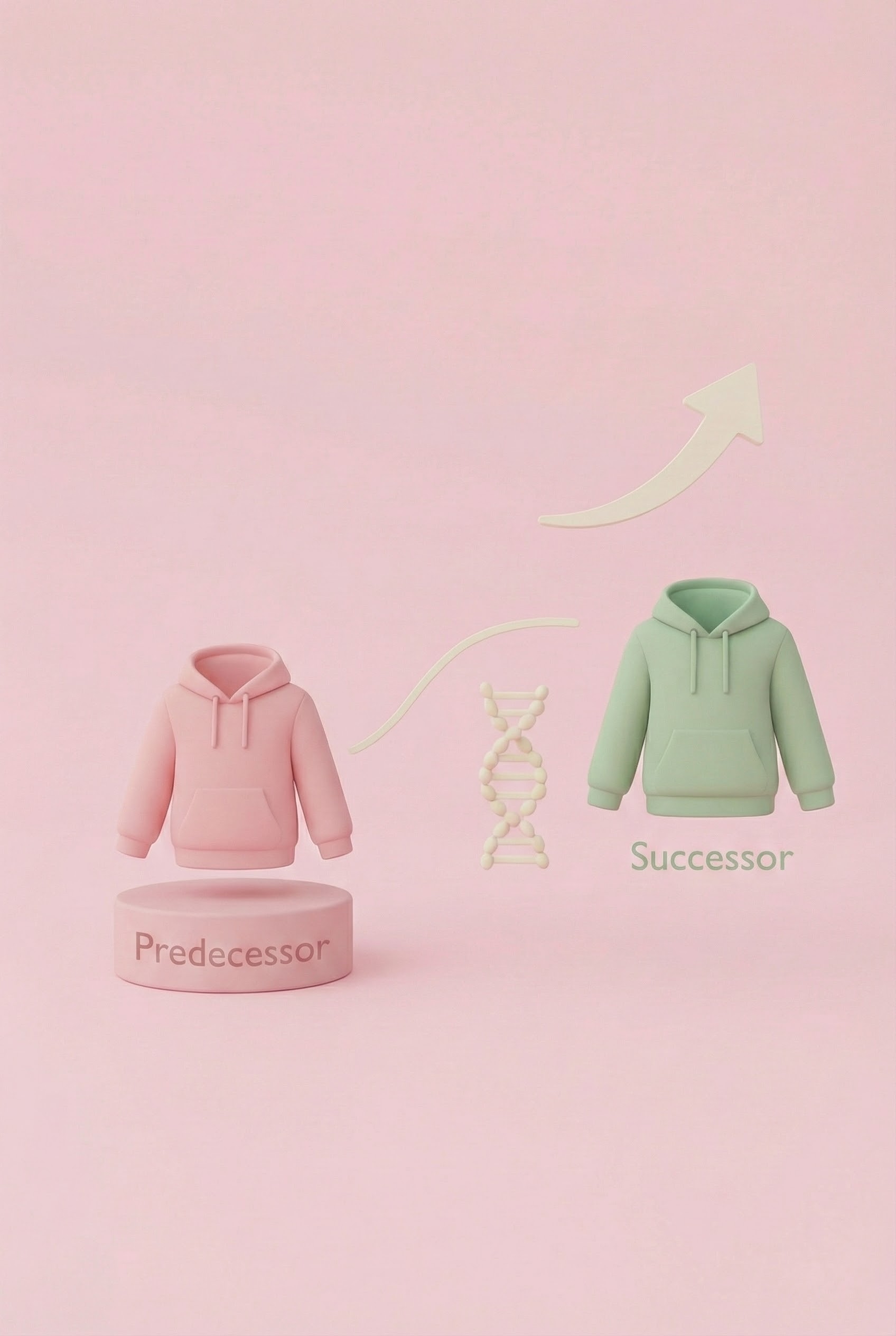
The solution is to stop treating these as two separate, disconnected problems and start viewing them as one single, connected event. This is the core concept of product supersession and the key to how to forecast new product demand accurately: the new product's forecast should be directly built on the proven sales history of the old one; it needs to "inherit" its sales DNA. This makes estimating demand for new products a data-driven process.
Your new SKU isn't really a brand-new product. It's a variation, and it shares the same "sales DNA" as your classic bestseller. It has the same fit, the same fabric, and it's aimed at the same customer, so it's going to follow a very similar sales pattern.
This is the core principle of smart assortment planning. It's about using the data from your proven winners to make intelligent bets on your new ones.
Your Assortment Plan
You understand the "why"—that you must use the "sales DNA" from your proven winners. Now you must choose the "how."
For a scaling D2C brand, there are realistically two paths you can take to implement this strategy: the integrated, automated path and the manual, spreadsheet-based path.
Option 1: The Manual Path
If you do not have an integrated tool, you can still follow the philosophy of this process manually, using spreadsheets.
First, you must export the sales history of your "Predecessor" product. You will need to pull this data at a granular level, ideally weekly, for at least one full year to capture its seasonal curve.
Second, you must "normalize" this data. This is the most critical step. You need to convert the raw unit sales into a percentage of the total annual sales.
Third, you must make an educated (but still manual) guess for the new "Successor" product. You have to decide on a total, high-level number you expect it to sell in its first year. This will still be based on your market analysis.
Finally, you apply the "sales DNA" to your new product. You will take that percentage-based seasonal profile from your old product and apply it to the total number you just guessed for your new one. This will give you a week-by-week unit forecast for your new SKU.
Example:
Use our example of the "Classic Navy Hoodie" as your "Predecessor" product. First, you look up its sales for the last 52 weeks and find it sold a total of 10,000 units. Then, you look at the sales for each individual week. You find that in a slow week in February (Week 6), you sold 100 units. But during your peak holiday week in December (Week 49), you sold 700 units.
"Normalizing" this data just means turning those unit numbers into percentages of the total.
→February Week 6: (100 units sold / 10,000 total units) = 1%
→ December Week 49: (700 units sold / 10,000 total units) = 7%
You would repeat this calculation for all 52 weeks. The final result is your "sales DNA"—a seasonal profile that shows, for example, that this hoodie always sells 1% of its annual total in Week 6 and 7% in Week 49. This percentage-based profile is now a clean, reusable map of your product's demand curve, which you can apply to any new, similar product.
You now have a forecast. The problem is that it is a static document. It is not connected to your replenishment. And if the "parent" product's trends suddenly change, your new forecast will be completely wrong.
While this manual recipe is better than pure guesswork, it is an imperfect solution to a problem that our modern inventory planning software is built to solve automatically.
Option 2: The Recommended Solution
The most efficient and scalable path is to use an engine designed for this exact purpose. This is where a dedicated inventory planning software solution, like Tightly, becomes essential.
Introducing our “Product Successor”: A New Way to Manage the SKU Lifecycle
As mentioned, your product isn't really a blank slate. What if you could just tell your new product to "inherit" the sales DNA of its older, proven sibling? That is the simple, powerful idea behind our new "Product Sucessor” feature in Tightly. It lets you tell us that a new product (the "Successor") should follow the exact same sales patterns as an existing, proven product (the "Predecessor").
How It Works
The moment you create this link, the new product instantly inherits all the reliable sales history and demand data from the old one.
For example, you can map one of your classic best-selling t-shirts to an entire new collection of colorways. You'll see clear visual tags on the planning page so you always know which items are linked, and you can easily "unlink" them later once the new products have gathered their own sales history.
→ You Are in Full Control of the Mappings
We've built a new, simple-to-use hub located at Demand → Product Successors. From this one screen, you can easily create, view, or delete these connections. It’s a simple and intuitive, not a complex technical setup.
→ You Can Map One-to-Many
This is perfect for new style forecasting or launching collections. Imagine you have one proven "Classic T-Shirt" (the Predecessor). You can now map it to multiple new Successors at once—like the new "Red," "Green," and "Yellow" versions. Tightly will automatically apply the classic shirt's demand plan to all three new colors, saving you from having to build three separate, manual forecasts.
→ Your Data Stays Locked and Consistent
Once you map a new product, its demand plan is "locked" to its predecessor's. This is a crucial feature. It means the new product's forecast isn't just a one-time copy; it will automatically update whenever the predecessor's plan changes. If you adjust the forecast for your main product, all its "children" products update instantly, ensuring your entire line stays in sync without any manual effort.
→ It Prevents Costly "Double-Counting"
We also built in a smart safeguard. When you map a new product, Tightly automatically excludes it from "Events." Why? Imagine you're running a "Summer Sale" Event. If both the new blue shirt and the old navy shirt were included, your forecast would double-count the promotion's impact. This feature ensures that only the main "Predecessor" product is counted, keeping your overall forecast clean and accurate.
You Get Clear Visual Indicators Everywhere
This kind of product supersession can get complicated, so we've made it easy to see what's happening at a glance. Across the Demand Planning page, you'll now see clear tags and tooltips. This tells your entire team exactly which products are linked, which is the "parent" item, and why a new product has a forecast. It creates a single source of truth for your entire planning team.
You Decide When a Product "Graduates"
This mapping isn't a permanent chains. We know that after a few months, your new product will have gathered its own sales history. You'll be ready to let it "graduate" and stand on its own. You are in complete control and can stop the predecessor-successor mapping at any time. The moment you do, Tightly will stop inheriting data and begin using the new product's own real-world sales history for all future forecasting.
→ For a more complete, step-by-step guide on how to set it up, manage the tool, and see it in action, you can read the full technical documentation in our knowledge base: Product Successors: How to Set Up
Who This Is For: From Guesswork to Confidence
This update is a game-changer for enterprise retailers who launch frequent product iterations, especially in apparel, electronics, or beauty. It's built for the planners and merchandisers who are responsible for managing seasonal collections and new style forecasting. It’s the missing piece for any brand that relies on data-driven replenishment but has been stuck in the guesswork cycle of forecasting for low-data products.
Tightly’s Product Successors finally lets you launch new products with the same confidence as your bestsellers.
Laura B
Marketing Analyst
Share